Why Most Supplement Brands Misjudge Manufacturing Capacity Until It’s Too Late
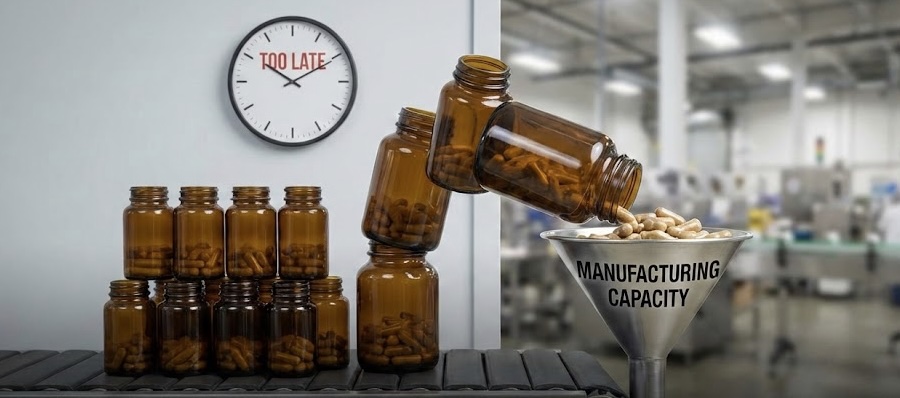
Supplement manufacturing capacity is one of the most misunderstood concepts in the industry. Many brands believe capacity is defined by equipment size, batch volume, or the number of production lines a manufacturer claims to have. In reality, capacity is a system. When demand increases, the cracks in that system are what determine whether a brand scales smoothly or stalls.
For growing supplement brands, misunderstanding capacity is rarely obvious at first. It only becomes clear when success arrives faster than expected.
Capacity Is Not Just Equipment
Early on, brands are often reassured by statements like “we can run hundreds of thousands of units” or “we have multiple lines.” While those claims may be technically true, they rarely reflect real-world execution.
True supplement manufacturing capacity depends on:
-
Raw material availability and lead times
-
Quality assurance workflows
-
Packaging and kitting schedules
-
Trained operators who can run consistently under pressure
Without alignment across all of these, equipment alone does not protect a brand from delays.
Where Capacity Breaks First in Supplements
When brands grow, capacity issues tend to surface in predictable places.
Raw materials are often the first constraint. Flavor systems, sweeteners, and specialty actives frequently have longer lead times than expected. When those materials arrive late, production windows collapse.
Quality control is another bottleneck. Certificates of analysis, release testing, and documentation must all move at the same pace as production. The FDA’s current Good Manufacturing Practice expectations make this non-negotiable
Packaging often follows. Sachets, bottles, labels, and secondary packs must all be staged correctly. A delay in one component can halt an entire run.
Demand Spikes Expose Weak Planning
Most capacity failures happen after good news. Influencer campaigns perform better than expected. Retail purchase orders arrive earlier than planned. Subscription volume ramps quickly.
At that moment, brands discover whether their manufacturer planned for growth or simply promised it.
Without reserved production windows, redundant sourcing, and people who have scaled before, even small delays compound into missed launches and stockouts.
What Real Supplement Manufacturing Capacity Looks Like
Scalable supplement manufacturing capacity is built deliberately.
It includes predictable scheduling rather than reactive slotting. It includes backup suppliers and realistic lead-time assumptions. It includes integrated operations and quality teams who plan together, not sequentially.
Most importantly, it includes people who have managed growth before and know where pressure builds first.
How HBM Plans Capacity for Growth-Stage Supplement Brands
At HBM, we work with brands manufacturing nutraceutical liquids and gummies who are moving from early traction into sustained growth.
Our capacity planning focuses on:
-
Domestic sourcing for tighter timelines
-
Integrated QA and operations workflows
-
Production schedules aligned to forecasted demand
-
Planning before the purchase order arrives
We design systems that hold up when volume increases, not just when things are calm.
If you are planning growth and want to understand what real capacity looks like, start here
To get started REQUEST A QUOTE here